

When my husband and I decided a few years back to lean harder into whole foods, I decided fresh vegetable juice would be part of that, not the whole plan, just part of it. I did not want a machine that ate up my three feet of counter or asked me to lift twelve pounds of steel every morning. I ordered the magic bullet Mini Juicer in the black finish back in February, mostly because the listing showed a 2 inch feed chute and a 16 ounce cup that looked like it would tuck into the cabinet over my stove if I ever needed it out of the way. I hesitated for almost a week before I ordered it, since I have been burned by kitchen gadgets before and did not want to waste money on another one. Six months later it is still on my counter most mornings, and this is everything I have actually learned about living with it, not just unboxing it.
I should say up front what kind of cook I am, because it changes what I notice. I am not chasing some big transformation here, I am a woman in her late seventies who cooks for two, who likes vegetables, and who has been burned before by kitchen gadgets that promised to change my mornings and then sat in a cabinet after three uses. So when I say this thing is still out on my counter six months in, that actually means something in this house, because most things do not survive that long around here.
The Quick Verdict
Six months and roughly five mornings a week of use later, the magic bullet Mini Juicer earns its spot on my counter. It is light enough for me to lift with one hand, the parts that touch juice go straight in the dishwasher, and the motor has not slowed down or smelled hot even once. It is not a replacement for a real cold press machine, and I would not pretend it squeezes out every last drop, but for a woman with a small kitchen and no interest in babying an eight part appliance, it has held up.
Amazon Check Today's Price →Tired of Juicers That Take Over Your Counter and Your Whole Morning?
The magic bullet Mini Juicer fits in about the space of a large mixing bowl and, in my experience after six months of near daily use, takes roughly four minutes from counter to clean. See today's price and current availability on Amazon.
Amazon Check Today's Price on Amazon →How I've Used It
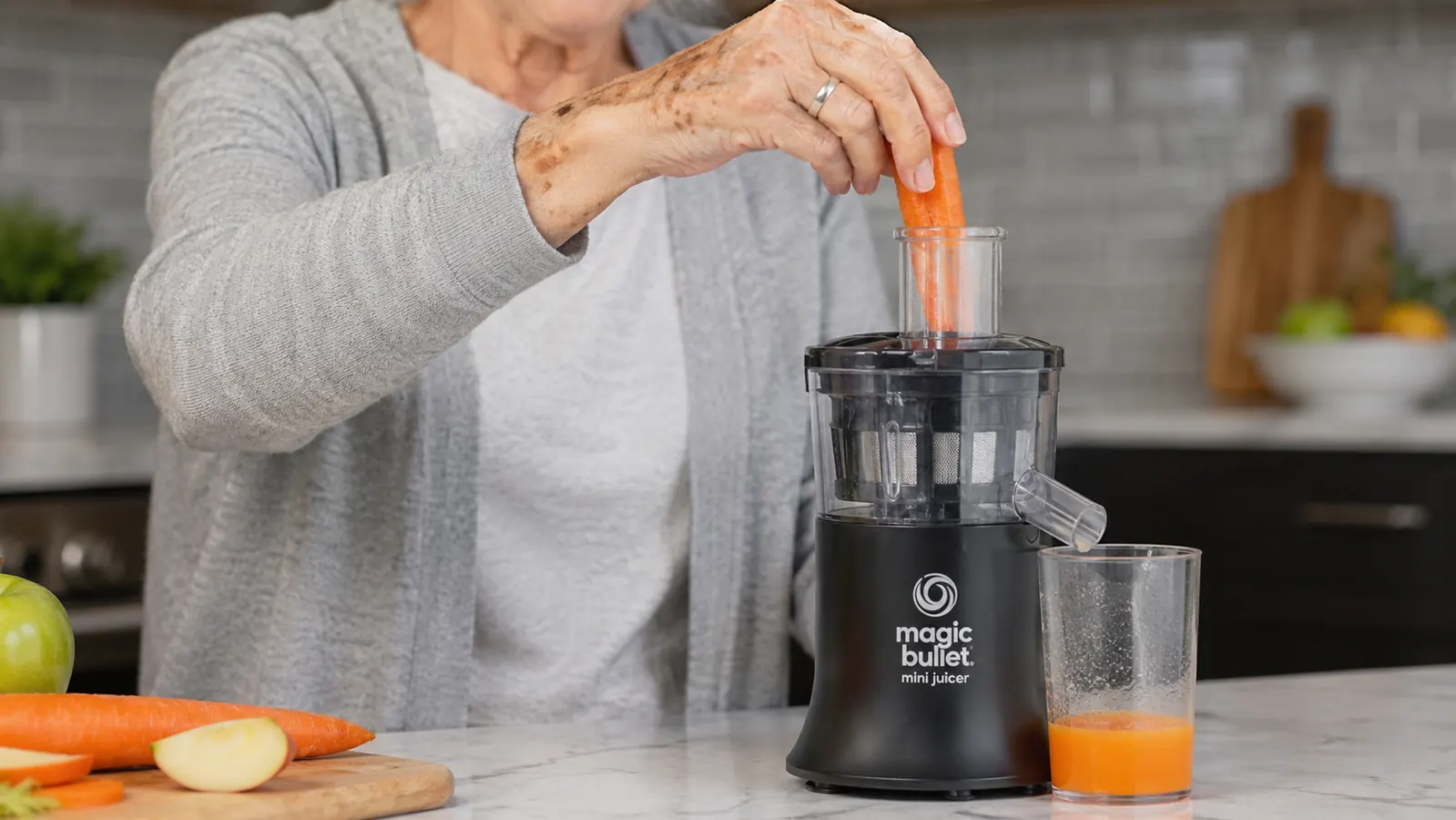
My routine settled in faster than I expected. Most mornings, after my husband has his coffee and I have mine, I pull two or three carrots, half a cucumber, and whatever green is not wilting yet out of the crisper. The feed chute is only about 2 inches across, so I am still cutting things into smaller pieces than I would like, but that has become such a habit now that I barely notice the extra minute or two it adds to the whole process.
I keep the juicer on the counter to the left of my sink, in the one spot where a bulkier machine simply would not fit alongside my toaster and my personal blender. It weighs little enough that I can pick it up with one hand to wipe underneath it, which matters more to me at my age than most product listings ever bother to mention. My husband has never once offered to lift it for me, because there has never been a reason to ask him.
I do not run it every single day. Some mornings we have oatmeal and toast and that is that. But over six months I would guess I have used it four to five mornings most weeks, which by my own rough math puts it somewhere north of a hundred sessions, closer to a hundred and twenty by my best count. That is not a scientific count, just the honest guess of a woman who has watched this little machine quietly become part of her routine instead of a chore she keeps putting off.
What Six Months of Almost Daily Juice Actually Did to It
I was waiting for something to go wrong, honestly. In my experience, small kitchen gadgets with a motor either fail within the first month or they settle in and just keep going, and this one settled in. The 400 watt motor has not changed its sound that I can tell, no new grinding, no burning smell, nothing that made me want to unplug it and shove it to the back of a cabinet for good, and that alone tells me more than any spec sheet ever could.
The strainer basket is the one part I keep an eye on, since that is where carrot fiber and pulp really work themselves into the mesh over time. After about four months I noticed it was not spinning out pulp quite as cleanly as it did when it was new, and juice was coming out a little thicker than I liked some mornings, so now I run it under hot water and go over it with an old toothbrush once a week instead of just rinsing it under the tap. That one small change fixed most of what I was seeing.
The 16 ounce cup and the black plastic housing still look close to new, no cracking, no cloudiness from the dishwasher, which honestly surprised me, because most of my plastic kitchen pieces go dull after a few months of hot cycles. I would not call this thing indestructible, six months is not forever, but it has held up better than a couple of appliances that cost me quite a bit more.
The Cleaning Routine That Finally Stuck
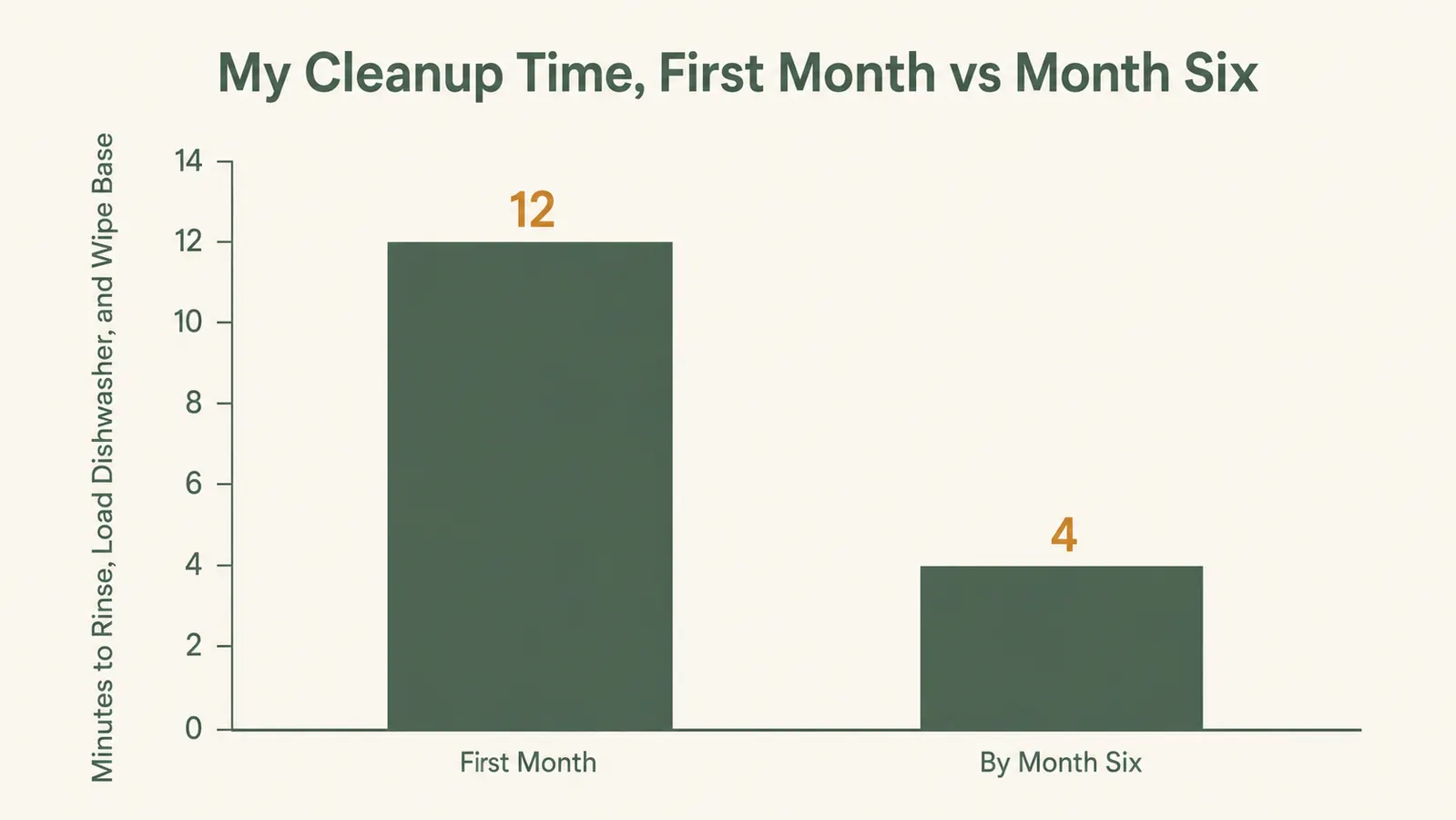
I will be honest, the first two weeks I almost gave up on this machine, not because it did not work, but because I was cleaning it the hard way. I was hand washing every single piece under the tap the way I always had with an old juicer years ago, and it was taking closer to twelve minutes some mornings, mostly because I was scrubbing the strainer basket by hand with a dish rag.
Once I actually read the little care card that came in the box, I learned the main parts are dishwasher safe, and that changed everything about how I felt toward this machine. Now I rinse the pulp out over the trash, drop the cup, lid, and strainer basket into the top rack, and wipe the base with a damp cloth since that part has the motor in it and cannot go anywhere near water. That whole routine takes me four or five minutes most mornings, down from the twelve it used to take, and it is the real reason this machine is still in use at all.
I keep a small brush by the sink just for the strainer mesh on the days I do not run the dishwasher, and that habit alone has kept the machine juicing cleanly instead of leaving me with watery, pulpy juice by the second month, which is roughly what happened before I settled into a real routine with it.
Small Counter, Small Machine: Where It Actually Lives
My kitchen has about three feet of usable counter between the stove and the sink, and that is being generous about it. Before this juicer, I tried a full size cold press machine a niece handed down to me, and it simply never left the box once I measured it against my counter. The magic bullet Mini Juicer, by comparison, takes up roughly the footprint of a large mixing bowl, and I can slide it back against the backsplash when I need the space for something else, like rolling out dough.
It is light enough that I do not dread pulling it out or putting it away, which matters more than most people realize until they are the ones lifting it every day. I have some stiffness in my hands most mornings, and grip strength is not something I take for granted anymore. This machine does not ask much of me beyond twisting the lid into place, and that alone has kept me from quietly avoiding it the way I ended up avoiding that cold press machine.
How Loud It Really Is
Nobody puts noise level in a product listing, so I will. This machine runs about as loud as my personal blender on its lower speed, loud enough that I do not try to use it while my husband is still asleep, but not so loud that I need to warn a guest before I turn it on. It is a quick whir, maybe fifteen to twenty seconds per glass of juice, nothing like the long grinding drone I remember from the juicer I owned twenty years ago and eventually gave away.
I mention this because in a small kitchen, sound carries into the whole house in a way it might not in a bigger place. My husband can be in the next room reading the paper and barely notices when I run it, which was not true of that old juicer I finally threw out. If a quiet kitchen matters to you as much as it does to me, this is one more small thing this machine has gotten right over six months of daily use.
What It Handled Well Over Six Months, and What I Stopped Trying
By month six I had a pretty clear sense of what this juicer was actually good at, and it turned out to be narrower than I first assumed. Carrots, cucumber, apple, and celery went through smoothly nearly every time, no matter how many mornings in a row I ran them. Ginger was a different story. I tried it maybe six or seven times over those months, cut into small coins the way I would for tea, and every single time the stringy fibers wound themselves around the strainer basket instead of juicing cleanly, leaving me with almost nothing in the cup and a real mess to pick apart afterward. I stopped bothering with ginger by month three and have not missed it.
Hard root vegetables were the other thing I gave up on. A dense chunk of raw sweet potato or a piece of butternut squash made the motor labor in a way carrots never did, a heavier, slower sound that made me stop and cut everything down even smaller before trying again, and even then the yield was thin for the effort involved. Soft fruit went the opposite direction. Watermelon and orange segments came out mostly foam with barely any real juice underneath, so I quietly moved those over to my personal blender and let this machine stick to what it does well.
One thing I did not see coming was staining. After juicing beets a handful of times, the clear parts of the strainer basket picked up a faint pink tint that a normal dishwasher cycle never fully lifted, though soaking it in warm water with a spoonful of baking soda every few weeks has kept it from getting worse. If someone asked me a year into owning this whether I would still buy it, I would say yes without much hesitation, but I would tell them plainly what it is actually for, carrots, cucumber, apple, celery, nothing more ambitious than that, and to let a blender handle the rest.

Alternatives I Thought About
Before I settled on this one, I looked seriously at a full size cold press juicer, the kind with the slow auger that people say pulls more juice out of the same vegetables, and I spent an evening reading through reviews and measuring my counter more than once before deciding against it. I go into that comparison in more detail in my side by side of the Magic Bullet Mini Juicer against a cold press juicer, but the short version is that the cold press machines I looked at were heavier, pricier, and took up far more of my counter than I was willing to give up permanently.
I also thought about just using my personal blender and straining everything through cheesecloth the old fashioned way, which I did for almost a year before I bought this. It worked well enough, but it was messy and it took longer than I wanted most mornings. If you are curious why I moved toward fresh juice as part of a whole foods routine in the first place, I wrote about that separately in 10 reasons fresh juice fits a holistic health routine.
What I Liked
- Light enough that I can lift and move it with one hand, even on mornings when my grip is not at its best
- Cup, lid, and strainer basket are dishwasher safe, which turned a twelve minute chore into a four minute one
- Small enough footprint that it actually stays out on my three feet of counter instead of living in a cabinet
- Motor has not slowed, ground, or smelled hot once across six months of near daily use
- Housing and cup still look close to new, no cracking or cloudiness after repeated dishwasher cycles
- Quiet enough that it does not disturb the rest of the house on an early morning
Where It Falls Short
- The 2 inch feed chute means I am still cutting produce into smaller pieces than I would prefer
- Strainer mesh needs a weekly scrub with a small brush or pulp starts building up in the fine holes
- It does not pull as much juice per carrot as the cold press machine I compared it against
- The 16 ounce cup is small, which means a refill mid recipe if I am juicing for both of us at once
I was not looking for a machine that changed my life. I was looking for one that would still be sitting on my counter six months later, and this one is.
Who This Is For
This little juicer is for someone with a small kitchen, limited counter space, and no patience left for an eight part machine that takes over the sink every time you use it. If you are cooking mostly for one or two people, want a quick glass of fresh vegetable juice a few mornings a week, and would rather spend four minutes cleaning up than twelve, this fits that kind of life.
Who Should Skip It
If you are juicing for a big household, want to run whole apples or thick beets through without a lot of pre cutting, or you are chasing every last drop of juice out of your produce, a larger cold press machine is probably going to serve you better than this one will. I would rather tell you that now than have you disappointed after you have already brought it home.
Still Earning Its Spot on My Counter After Six Months
That is not something I can say about most kitchen gadgets I have bought over the years. If a compact juicer that is easy to lift and easy to clean sounds like what your kitchen needs, check today's price on Amazon.
Amazon Check Today's Price on Amazon →