

My neighbor's daughter, home visiting for a few weeks last spring, watched me pull the magic bullet Mini Juicer out of the cabinet one morning and asked why I hadn't just bought one of those big cold-press juicers everybody online seems to swear by. It's a fair question, and I'd wondered the same thing myself before I bought mine. I have about three feet of usable counter between the stove and the sink, and I did not want to give a third of it over to a juicer the size of a small toaster oven that takes ten minutes to break down and wash after every glass. So before I answered her question, or yours, I actually used both machines, my compact magic bullet Mini Juicer and a friend's full-size cold-press juicer, on the same produce, over the same couple of weeks, so I could compare them honestly instead of guessing.
The honest answer is that neither one is the better juicer in every single way. If you're judging strictly by how much juice comes out of a pound of carrots, or how long that juice stays good in the fridge, the cold-press juicer wins, and it isn't close. But if you're judging by how much of your counter it takes up, how much muscle it takes to lift and load, how fast you can get a glass of juice on a Tuesday morning, and how many parts you're left rinsing in the sink afterward, the magic bullet Mini Juicer wins those categories just as clearly. For my kitchen and my hands, that second list mattered more, so the Mini Juicer is the one I still reach for most mornings. Here's the row-by-row breakdown so you can weigh it against your own kitchen instead of mine.
I've spent enough on kitchen gadgets over the years to know a rating on a listing doesn't tell you much on its own either. The magic bullet Mini Juicer I own carries several thousand ratings and holds up around four and a half stars, which was reassuring before I bought it, but the real test was always going to be my own counter and my own carrots, not a screen full of stars from people I've never met.
| magic bullet Mini Juicer | Cold-Press Juicer | |
|---|---|---|
| Counter Footprint | Small enough to leave out permanently in a corner | Close to twice as tall, needs a dedicated spot |
| Weight to Lift and Carry | Light enough to move with one hand | Heavy base, awkward to shift on and off a shelf |
| Time from Produce to Glass | A couple of minutes, one button | Closer to ten minutes, fed slowly through a narrow chute |
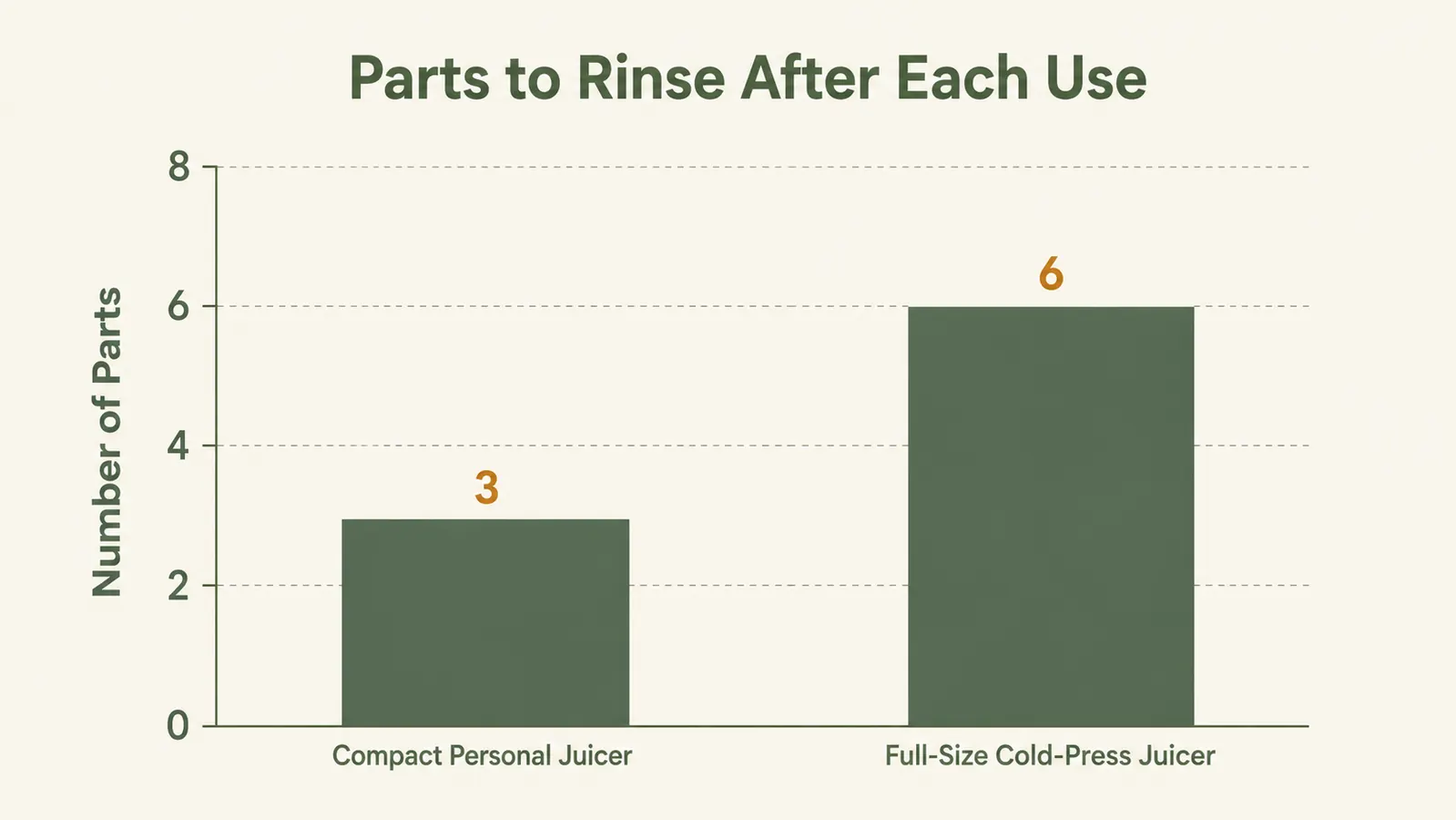
| Parts to Wash Afterward | Cup, blade, and lid, all dishwasher safe | Several parts including a mesh screen that needs hand scrubbing |
| Juice Yield Per Pound of Produce | Leaves pulp that's still visibly damp | Pulls out noticeably more liquid, drier pulp left behind |
| Noise Level | Loud enough to wake a sleeping household | Considerably quieter |
| How Long Juice Keeps in the Fridge | Starts separating and dulling by the second day | Still looks and tastes fresh on day three |
| Current Price | Runs well under a full-size cold-press machine | Typically the bigger upfront cost of the two |
How I Tested Both Machines
I borrowed my friend's cold-press juicer for two weeks in April and ran it side by side with my own Mini Juicer, feeding both machines the same bag of carrots, the same bundle of celery, and the same handful of apples each time, so I wasn't comparing apples to, well, something else entirely. I timed how long each juicer took from produce on the counter to juice in the glass, counted every single piece I had to wash afterward, and kept the juice from both machines in matching jars in the fridge to see which one held its color and its taste longer.
I also paid attention to something a spec sheet never mentions, which is how tired my hands and shoulders felt afterward. My grip isn't what it used to be, and feeding whole carrots into a narrow chute and pushing them down with a plunger for several minutes straight is a different kind of effort than dropping chopped produce into a cup and pressing a button. That difference showed up every time I used the cold-press machine, and it's a real cost even though no chart measures it in ounces.
I ran this same comparison three separate weeks in April, not just once, because a single morning can be misleading if the produce happens to be unusually ripe or the fridge runs a touch colder than usual that day. Each week I bought a fresh bag of carrots, a bundle of celery, and a handful of apples from the same market, split the batch evenly, and ran half through my Mini Juicer and half through my friend's cold-press juicer within minutes of each other. That gave me three separate readings instead of one, and the pattern held steady every single time, which is part of why I trust it enough to write down here.
Where the magic bullet Mini Juicer Wins
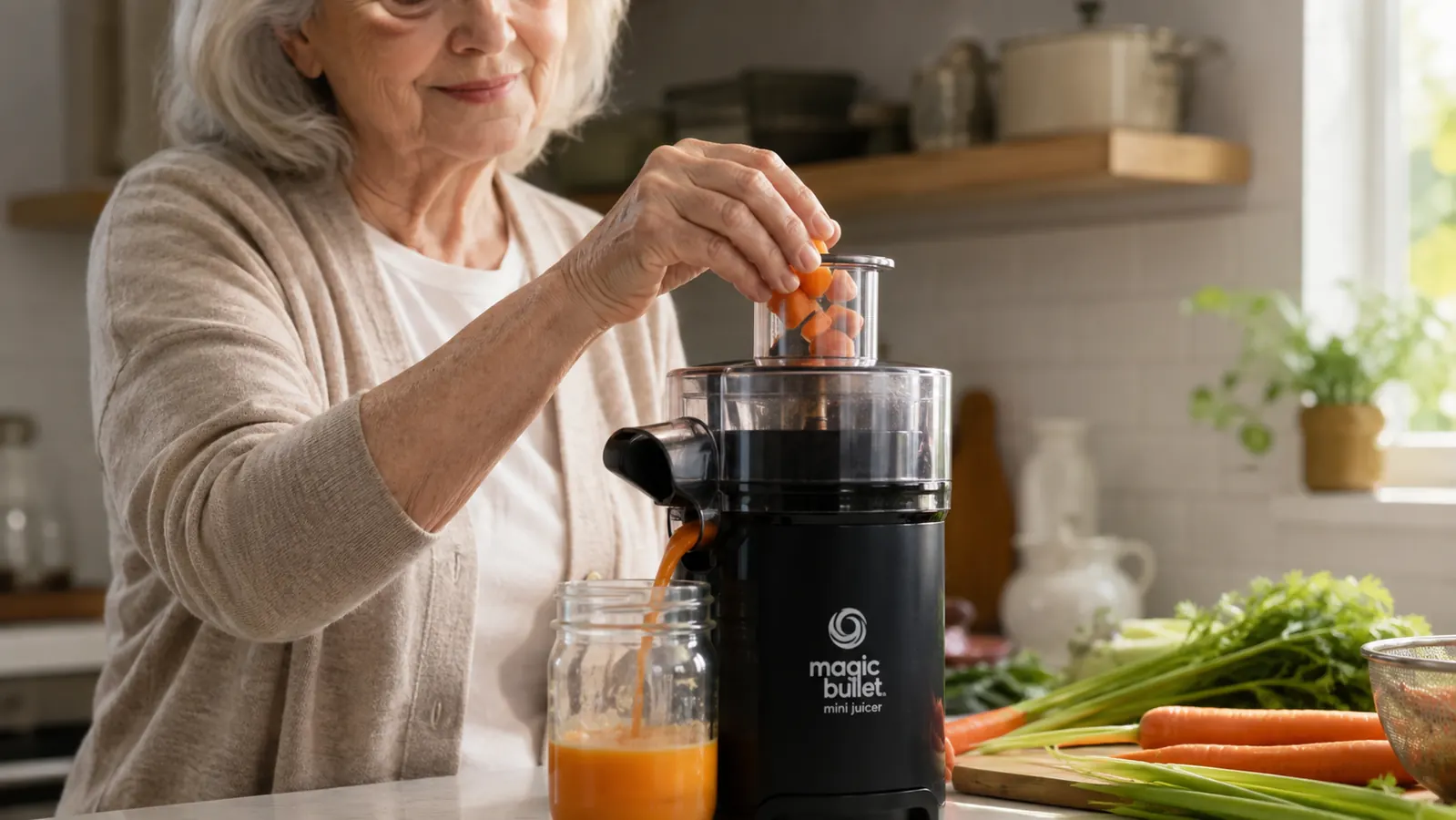
Counter space is the first place my Mini Juicer wins outright. It's small enough that I keep it out permanently in the corner by the window, and it still leaves me room to work. My friend's cold-press juicer is close to twice as tall and considerably wider at the base, and she keeps hers in a cabinet, hauling it out only when she's committed to a real juicing session, because finding it a spot on her counter means moving something else out of the way first.
Speed and effort are the other big win. With the Mini Juicer, I drop in a handful of chopped fruit or vegetables, press the button, and I'm rinsing the cup within a couple of minutes. The cold-press juicer asks for narrow strips of produce fed slowly through a chute with a plunger, which took me closer to ten minutes for the same amount of juice, and by the end my hand and wrist were feeling it. On a weekday morning when I'm also trying to get my husband's toast going and take my own vitamins, those extra eight minutes and the wrist strain both matter more than they sound like they would.
Cleanup follows the same pattern. The Mini Juicer breaks down into just a few pieces, the cup, the blade, and the lid, and every one of them goes straight into the top rack of my dishwasher. I'm not standing at the sink with a little brush trying to work pulp out of a fine mesh screen, which is exactly what my friend has to do with her cold-press juicer every time she uses it. She's told me more than once that the cleanup is the real reason hers sits unused for weeks at a stretch.
There's also something I hadn't expected going in. Because the Mini Juicer leaves more pulp behind in the cup rather than ejecting it into a separate bin, I've started spooning a bit of that leftover carrot and apple pulp straight into my morning oatmeal instead of throwing it out, which fits how I like to cook, using as much of the whole vegetable as I reasonably can instead of just the liquid. The cold-press juicer ejects its pulp automatically into a separate container, which is tidier if you're planning to compost it, but it also means that pulp is gone the moment it's made, and I don't get the chance to use it the way I do with the Mini Juicer.
Where the Cold-Press Juicer Wins
I want to be fair here, because the cold-press juicer earns its reputation in a couple of places the Mini Juicer just can't touch. The biggest is yield. Feeding the same pound of carrots through both machines, the cold-press juicer consistently pulled out noticeably more liquid, leaving behind drier, almost powdery pulp, while the Mini Juicer left pulp that was still visibly damp. If you're juicing to stretch your produce as far as it will go, or feeding a bigger household, that difference adds up fast.
The cold-press juicer is also the quieter machine by a wide margin. My husband was still asleep down the hall most mornings I tested it, and the cold-press barely stirred him, where the Mini Juicer's motor is loud enough that I try to run it after he's already up. And the juice itself kept noticeably longer in the fridge. The juice from the cold-press juicer still looked and tasted fresh on day three, while the juice from the Mini Juicer had started separating and dulling in color by the second day, which lines up with what I've read about the slower cold-press method exposing the juice to less air as it's made.
I should also be fair about a place the Mini Juicer struggles that the cold-press machine handles better, which is leafy greens. I tried running a handful of spinach through my Mini Juicer on its own and got very little liquid back for the effort, mostly just wilted green pulp left behind. The cold-press juicer, built around a slower auger instead of spinning blades, pulled a real amount of juice out of that same spinach without much trouble. If leafy greens are going to be a regular part of your juicing, that's worth knowing before you buy either machine.
Ready for Juice in Minutes Instead of a Ten-Minute Production?
The magic bullet Mini Juicer clears a glass of fresh carrot or apple juice in a couple of minutes, with just a cup, a blade, and a lid to rinse afterward. See today's price and current availability on Amazon.
Amazon Check Today's Price on Amazon →What Neither Juicer Solved
Neither machine solved the problem of getting produce ready before it even reaches the juicer. I still have to wash, peel when needed, and chop everything by hand for both machines, and that prep time is roughly the same no matter which one is waiting on the counter. If you're hoping a juicer will cut your morning prep down to almost nothing, neither of these will get you there. Whatever time you save shows up in the machine itself, not in getting the produce ready for it.

A Morning That Made Up My Mind
The morning that actually settled this for me had nothing to do with any chart. I'd promised to bring a jar of fresh carrot-apple juice to a friend's house for a late breakfast, and I was running behind because I'd overslept a little. I reached for the Mini Juicer, dropped in the chopped produce, and had a full jar poured and capped in under five minutes, cup rinsed and back in the cabinet before I even left the house. If I'd had to feed produce through the cold-press juicer's narrow chute that morning, I'd have walked in late with juice still dripping down the side of the jar. That's really what this whole comparison comes down to for me, which machine fits the morning I actually have, not the morning I wish I had more time for.
Who Should Buy Which
If you're juicing in real volume, maybe for a household of several people, or you're trying to get the most juice possible out of every pound of produce, and you don't mind spending extra time on cleanup and a slower feed, the cold-press juicer is worth the extra counter space and the extra minutes. It's the better machine on paper for anyone chasing maximum yield, leafy greens, and juice that holds up over several days in the fridge.
If you're juicing for one or two people, working with a small kitchen the way I am, and you'd rather have a glass of juice in your hand in a few minutes than spend ten feeding produce through a chute and scrubbing a mesh screen afterward, the magic bullet Mini Juicer is the one I'd point you toward. I go into more detail on how mine has held up after regular use in my honest review, and if you want the exact routine I use with it most mornings, I wrote up how I make fresh vegetable juice at home as well.
There's also a middle option worth mentioning honestly. If leafy greens are a big part of your routine, you might end up wanting both eventually, a cold-press machine for green juices and a quick machine like the Mini Juicer for a fast glass of carrot or apple juice on a busy morning. I haven't gone that route myself, mostly because I don't have the counter space to keep two juicers out at once, but it's a real option if your kitchen has more room to work with than mine does.
See Why This Is the Juicer Still Sitting on My Counter
Small footprint, a few dishwasher-safe parts, and juice in minutes instead of a ten-minute production. Check today's price and current availability on Amazon.
Amazon Check Today's Price on Amazon →