
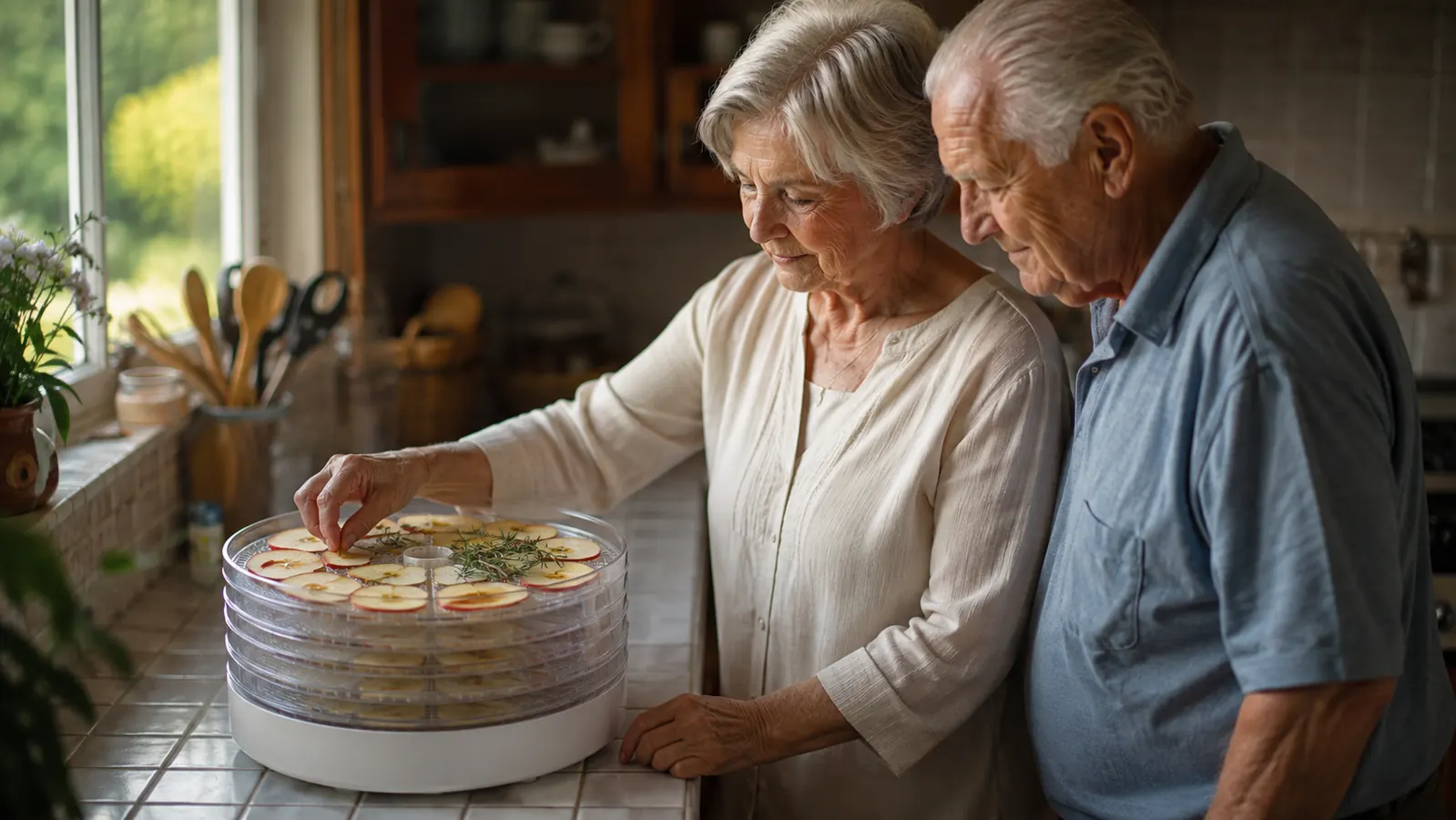
I bought the Presto Dehydro Electric Food Dehydrator in early March, mostly because my garden was about to give me more herbs and tomatoes than my husband and I could eat fresh, and I hate throwing away food I grew myself. I have about three feet of usable counter in my kitchen, so before I ordered it, I checked the dimensions three times over and asked myself whether I really had room for one more appliance. Six months later, three tomato harvests and a whole spring of drying mint and thyme behind me, I can finally answer that question honestly instead of guessing from a product listing.
I want to be upfront that I am careful with money and I have bought things before that promised to simplify my kitchen and instead added one more box to store and one more set of parts to scrub. This review is not a rushed first impression written the week the box arrived. It is what actually happened across spring, summer, and now the start of fall, including the parts that surprised me and the ones that annoyed me.
The Quick Verdict
Six months in, the Presto has earned a permanent spot in my kitchen, even though it does not live out on the counter full time. It is light enough for me to lift, has far fewer pieces to wash than I feared, and it has dried everything from herbs to tomatoes without a single hiccup. The lack of a temperature dial and the noise over a long run are the two honest tradeoffs.
Amazon Check Today's Price →Watching Garden Produce Go Soft in the Fridge Before You Can Use It All?
The Presto Dehydro turned a counter's worth of herbs and tomatoes into jars that keep for months, without me needing a bigger kitchen or a heavier machine to do it. See today's price and current availability on Amazon.
Amazon Check Today's Price on Amazon →How I've Used It
The first thing I dried was mint and thyme from a raised bed my husband built for me two springs ago, back when I only had the vaguest plan for what I'd do with a food dehydrator. I laid the sprigs flat on two trays, ran it overnight, and woke up to jars of herbs that smelled stronger than anything I'd ever bought dried at the store. That first success is really what turned this from a purchase I was second-guessing into a machine I use on a regular schedule, and it is what convinced my husband, who was skeptical of the whole idea, to start asking when the next batch would be ready.
By June I was drying apple slices most weeks and running a full batch of tomato slices from the garden every ten days or so through August, when the vines were producing more than we could eat, can, or give to neighbors. I have also dried a batch of zucchini chips twice, once successfully and once too thick, which taught me that a mandoline slicer is worth the extra counter clutter on tomato and zucchini days specifically. Most weeks it runs once, sometimes twice if I'm behind on the garden, and lately I've started drying orange peel too, since I hate wasting the peel from the oranges we eat most mornings.
It does not live out on my counter permanently, which matters given how little space I have. I run it, let it cool, then stack the trays back into the base and set the whole thing in a plastic tote in the pantry closet until the next batch. That habit took me a week or two to settle into, but now it is as automatic as putting the coffee maker away would be if I had a place to put it.
The Trays and the Motor: What Six Months of Stacking Taught Me
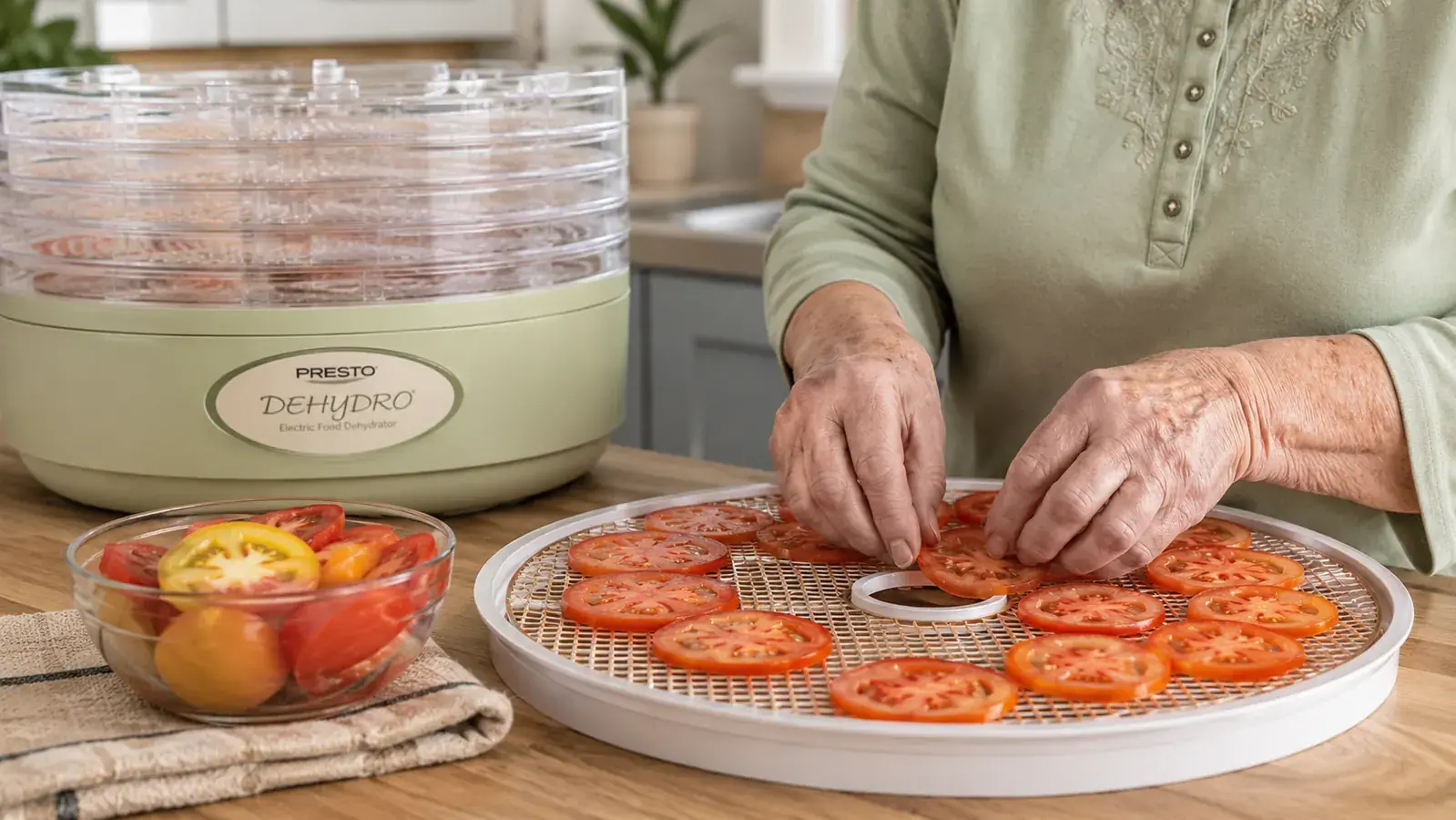
The Presto Dehydro is a round, stacked design, six mesh trays sitting one on top of the other with the motor and fan built into the lid at the top, blowing warm air down through the whole stack. There is no separate control panel to speak of. You plug it in, it runs, and you unplug it when you're done or when a kitchen timer tells you to check. For someone who does not want to fuss with settings, that simplicity was a relief the first time I used it. For someone who wanted more precision on my first tomato batch, it took some getting used to.
There is no thermostat or temperature dial, which is the single biggest adjustment coming from what I expected a dehydrator to have. It runs at one fixed heat setting, and the way you control the outcome is by how thin you slice, how full you load the trays, and how long you let it run. My first tomato batch came out slightly leathery in the center because I sliced too thick and didn't check often enough. My second and third batches, sliced thinner and checked at the four and six hour marks, came out right. That is a genuine learning curve, not a flaw exactly, but it is not the plug-and-forget experience some dehydrators promise.
The trays themselves have held up better than I expected. None of the six have warped or cracked after six months of regular use, including several batches where I loaded them heavier than the instructions probably recommend. I was genuinely bracing for at least one to bow out of shape by midsummer, given how much direct heat they take run after run, but they still stack flush and sit flat when I check them against the counter. The mesh itself has not sagged or torn either, even under the weight of a fully loaded tray of wet tomato slices.
How Loud It Gets After Hour Six
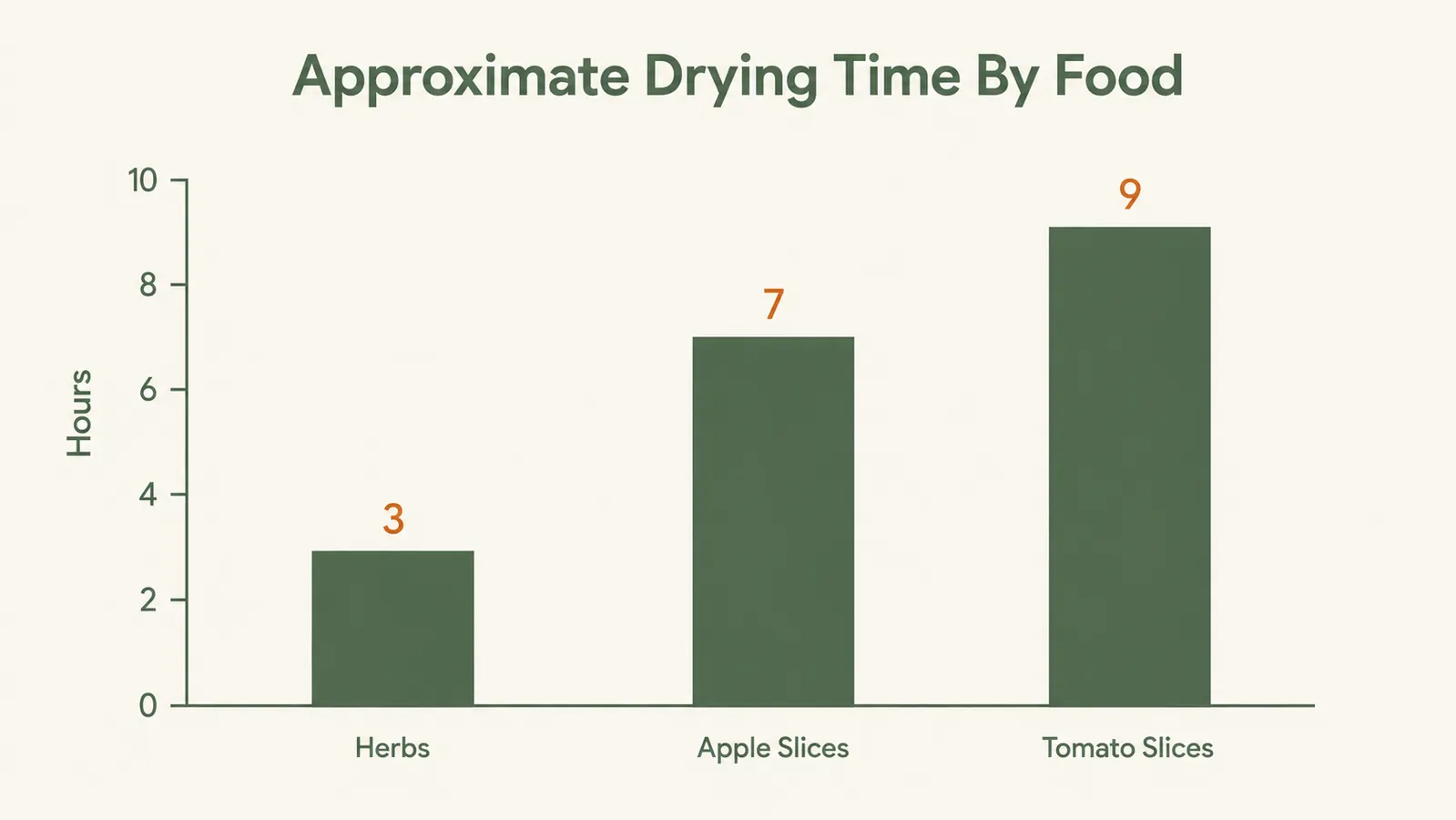
I need to be honest about the noise, because it matters at my age the way it matters to a lot of people who are sensitive to constant background sound. The Presto runs a steady fan hum the entire time it is on, and unlike a blender or a mixer, it is not over in twenty seconds. A batch of herbs might only need three hours, but a full tray of tomato slices can run eight or nine hours to dry through properly, and that hum does not let up the whole time.
I have learned to run it in the laundry room off the kitchen rather than directly on my counter, mostly for this reason, since the hum carries through the house more than I expected on my first overnight batch. It is not a loud, grinding noise, more like a small box fan running continuously, but if you are someone who cannot sleep with any hum in the next room, plan for where you'll put it during a long run before your first batch, not after.
What Two Seasons of Storage Did to It
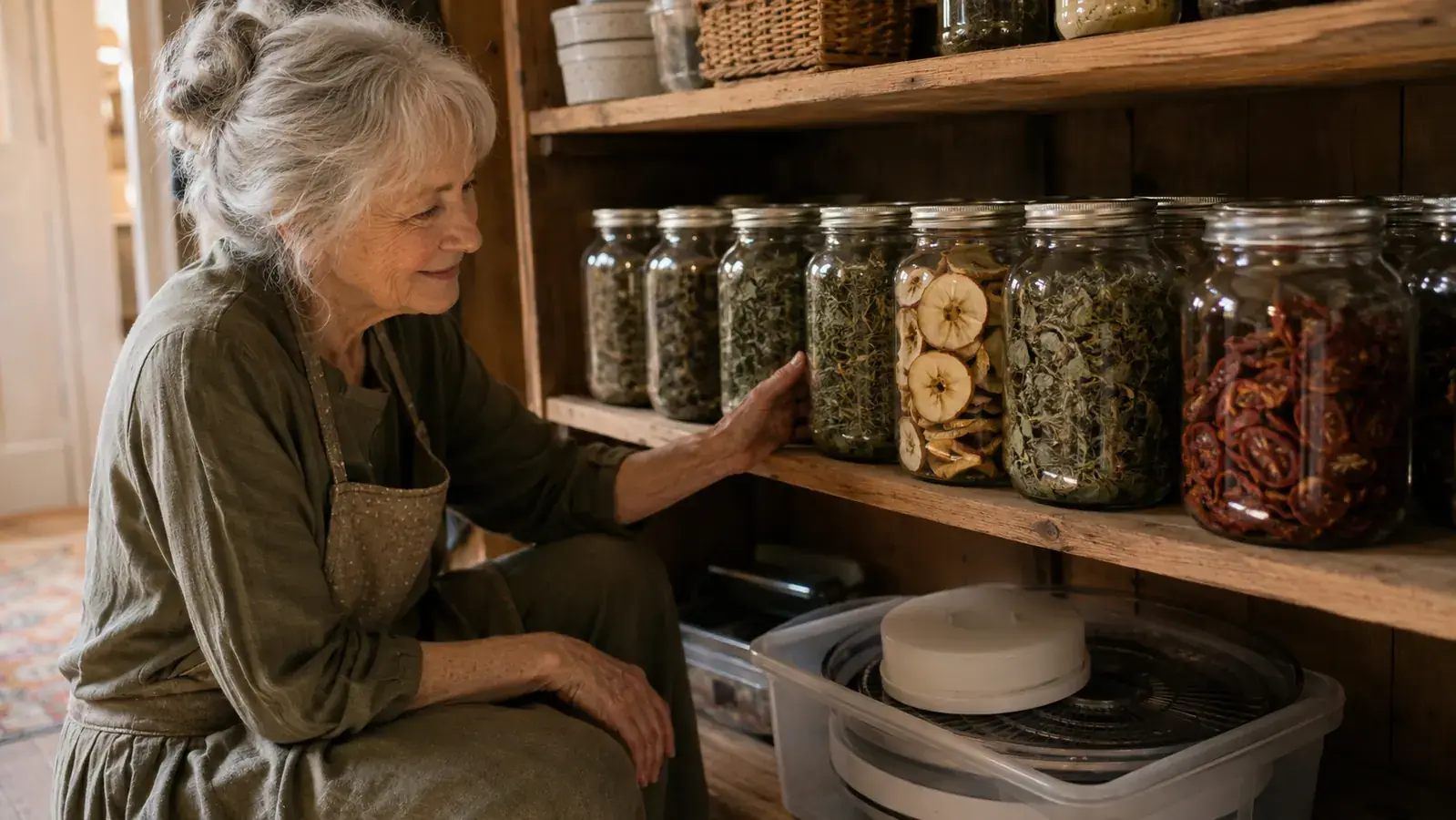
Storing it between uses is where I had the most worry going in, because my kitchen genuinely does not have room for one more thing sitting out. The stacked trays and lid nest down into a fairly compact tower, and the whole unit fits into a plastic tote I already had, tucked onto a pantry shelf between canning jars and a stockpot I rarely use. It comes out, runs for a batch, cools, gets wiped down, and goes right back in. That routine has not changed once in six months, and I appreciate that it did not require me to clear a permanent spot the way a stand mixer would have.
Going from a mild spring into a hot, humid summer here did not seem to affect the motor at all. I was a little worried the heat coming off a hot kitchen plus a dehydrator running for nine hours straight in August might strain something, but it never shut off early or ran hotter to the touch than it did in March. The one thing humidity did affect was drying time itself. My August tomato batches ran closer to nine hours instead of the seven a spring batch took, simply because the air in the kitchen was already carrying more moisture for the fan to fight against.
Cleanup between uses is genuinely easier than I feared going in. I hate washing a machine with eight loose parts, and this one comes close to that number if you count all six trays separately, but each tray is lightweight, dishwasher safe on the top rack, and rinses clean under warm water in about ten seconds if there is no sticky fruit residue. The base and lid, where the motor lives, never touch food directly, so a damp cloth wipe is all they've ever needed.
Alternatives I Considered
Before I bought this one, I looked seriously at a squarer, boxier dehydrator from a different brand that a friend recommended, mostly because it advertised an adjustable temperature dial, which the Presto does not have. I go through that comparison in more detail in a separate piece on the Presto Dehydro versus a Cosori-style dial dehydrator, if you're weighing the two the way I was. Short version here is that the dial model cost more and took up a squarer, boxier footprint that would not have fit as neatly into my pantry tote, and my friend who owns one still has to check her trays by hand anyway.
I also considered simply air-drying herbs the old-fashioned way, tied in bundles and hung from a hook, which I still do occasionally for a small handful of sprigs. For anything more than that, or for tomatoes and apples, the dehydrator is faster and far more consistent than leaving trays out on the counter and hoping for dry weather, which our humidity does not reliably give me. If you want the fuller list of reasons drying has become part of how I handle whole-food cooking, I laid that out in a separate piece on why dehydrating preserves whole foods worth reading.
A Full Year Later: What Was Worth the Electricity and the Hours
By the time this dehydrator crossed its first full year in my kitchen this past March, I had a clearer sense of what earned its keep. The tomatoes and herbs paid for themselves many times over, mint and thyme especially, since a jar of my own dried herbs replaces four or five little spice jars I used to buy at the store. Apple slices were a close second, my husband snacks on them instead of chips most afternoons now. Where I lost enthusiasm was mushrooms, which ran closer to twelve hours for a full tray, and the electricity plus the tending didn't feel worth it for something I use so rarely. I haven't dried a batch since that first try.
The dried food itself has held up better than I expected once it's off the trays and into a jar. Herbs from that first spring batch still smell strong when I open the jar today, over a year later, and apple rings I dried last October were still good, if slightly leathery, into February. I keep everything in glass jars with tight lids rather than plastic bags, which has helped more than the dehydrator did on its own. I also worried the plastic trays would hold onto smell after strong runs, but two batches of onions and garlic left no lingering smell in my next batch of apples, even with just the usual rinse.
Overnight Versus Daytime, and What I'd Tell You a Year In
I run it overnight far more often now than I did that first spring, mostly because of the noise I mentioned above. Starting a batch around nine at night means it's done, or close, by the time I'm up for coffee, and I don't have to plan my day around a steady hum in the next room. The one exception is a thick tomato batch, which I still start in the morning so I'm awake to check on it.
If you're asking whether I'd buy it again a year in, the answer is yes, though I'd go in with steadier expectations than I had that first week. It hasn't made drying food effortless, and it isn't quiet, but it has become as normal a part of my routine as canning was for my mother, and it has paid for itself in produce I would have otherwise composted.
What I Liked
- Light enough for me to lift the whole stacked unit with two hands, no strain on my back
- Trays have not warped or cracked after six months of regular, sometimes overloaded use
- Cleanup is a quick rinse per tray, dishwasher safe on the top rack
- Compact enough stacked and stored to fit in a tote on a pantry shelf
- Motor ran the same in a humid August as it did in a mild March, no drop in performance
Where It Falls Short
- No thermostat or temperature dial, one fixed heat setting for everything you dry
- Genuinely loud over a long run, I keep it off my main counter for anything past a few hours
- No digital timer, you need your own kitchen timer and to check trays manually
- Thicker slices or a full tomato harvest can mean an eight or nine hour run
It did not turn me into someone who never wastes garden produce again. It just gave me somewhere to put the extra before it went soft in the fridge.
Who This Is For
This is for anyone cooking for one or two people who grows even a small amount of their own produce or buys more fruit and herbs than they can eat fresh, and who does not want a heavy or complicated machine to preserve the extra. If you have limited counter space and are willing to store it between uses rather than leave it out, the Presto has genuinely earned its keep in my kitchen over six months and two full growing seasons.
If you want a walkthrough of how I actually load and run a batch from start to finish, I wrote a separate step-by-step piece on how to dehydrate fruit and herbs at home that covers the slicing and timing details I only touched on here.
Who Should Skip It
If precise temperature control matters to you, say for consistently drying a specific food at a specific setting, the lack of a dial here will frustrate you, and you'd be better served by a dial model even at a higher price. And if you cannot tolerate a steady fan hum running for several hours in your home, or you have nowhere at all to run it away from a bedroom or a quiet room, this is not the appliance that will make that easier.
Ready to Stop Watching Garden Produce Go to Waste?
Two growing seasons in, this is still the machine I reach for every time the tomatoes or the herb bed get ahead of me. Check today's price on Amazon and see if it's in stock.
Amazon Check Today's Price on Amazon →