
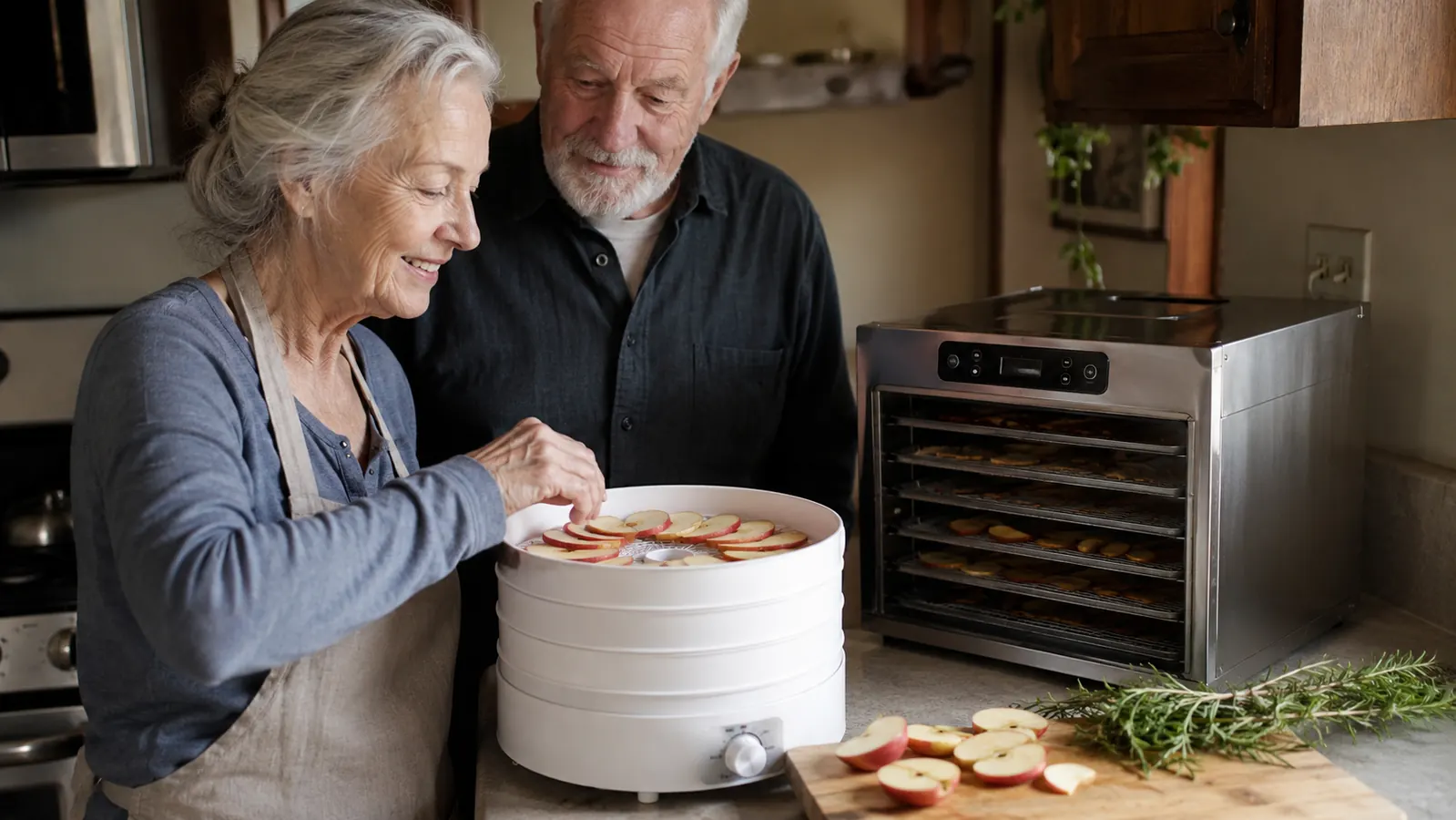
A neighbor two doors down mentioned last spring that she'd been eyeing one of those tall digital Cosori food dehydrators after seeing it recommended online, and she asked if I thought it was worth the jump over the plain Presto Dehydro I already had sitting on my counter. I didn't have a confident answer for her, because I'd only ever used the one machine, so I borrowed her Cosori for a season and ran both side by side, drying the same apples, the same herbs, and the same batches of turkey jerky my husband likes, to see for myself which one actually earned a permanent spot in a small kitchen.
The short answer is that the Presto Dehydro is the one that's still out on my counter today, mostly because it's simple enough that I never have to think twice before starting a batch, it's light to carry to the sink, and it nests down small when I'm done. The Cosori isn't a bad machine at all, and it genuinely does some things better, digital temperature control chief among them, but it's a bigger, heavier piece of equipment that asks more of both the counter and the person running it. I'll go through exactly where each one held up and where each one fell short, because three months of drying the same foods in both gave me a fair, honest picture.
How I Ended Up Comparing These Two Dehydrators
I bought the Presto Dehydro a couple of years ago after my husband started asking for dried apple rings the way his mother used to make them, plain, no added sugar, just apples sliced thin and dried until they had a little chew left. It's a round machine with stacking trays and one simple dial on top for setting the temperature, and it's lived on the same shelf in my pantry since, coming out most often in the fall when apples are cheap at the farmers market and I want to put some away without freezing them.
When my neighbor asked about the Cosori, I realized I couldn't honestly compare something I'd never touched, so I asked to borrow hers for a few weeks. What started as a few weeks turned into three months, because once I had it out I kept using it alongside my own dehydrator just to be fair to both. I ran the exact same recipe through each one, the same batch of thin-sliced Granny Smith apples with a little lemon juice, the same trays of basil and oregano from the garden, and the same marinated turkey strips for jerky, so I wasn't comparing two different foods, just two different machines doing the same job.
My husband, who has strong opinions about jerky texture but very little patience for reading instructions, ran the Cosori's digital panel a few times on his own while I stuck with my familiar dial. He got the hang of the buttons after the first try, but he mentioned more than once that he had to stop and think about which button did what, where with my Presto he could just turn the dial to where he remembered it being and walk away.
| Presto 06300 Dehydro | Cosori Food Dehydrator | |
|---|---|---|
| Today's Price | Lower current price on Amazon | Runs noticeably higher for the digital model |
| Temperature Control | One dial, no exact number displayed | Digital panel with a specific set temperature shown on screen |
| Maximum Tray Capacity When Fully Stacked | Expands with add-on trays, but takes up more vertical room per added tray | Stacks a full set of trays inside one enclosed cabinet without the stack growing as tall on the counter |
| Fan Noise During a Long Batch | A steady hum I can hear from the next room | Quieter overall, the enclosed cabinet seems to muffle the fan |
| Learning the Controls the First Time | One dial, nothing to remember or reprogram | Took my husband a try or two to get comfortable with the button sequence |
| Weight to Lift and Carry to the Sink | Light enough for me to carry with one hand | Noticeably heavier, I need both hands and a clear path |
| Storage Footprint When Not in Use | Trays nest down into a shorter stack that fits my pantry shelf | Stays roughly the same tall, boxy shape whether it's running or not |
Where the Presto Dehydro Wins
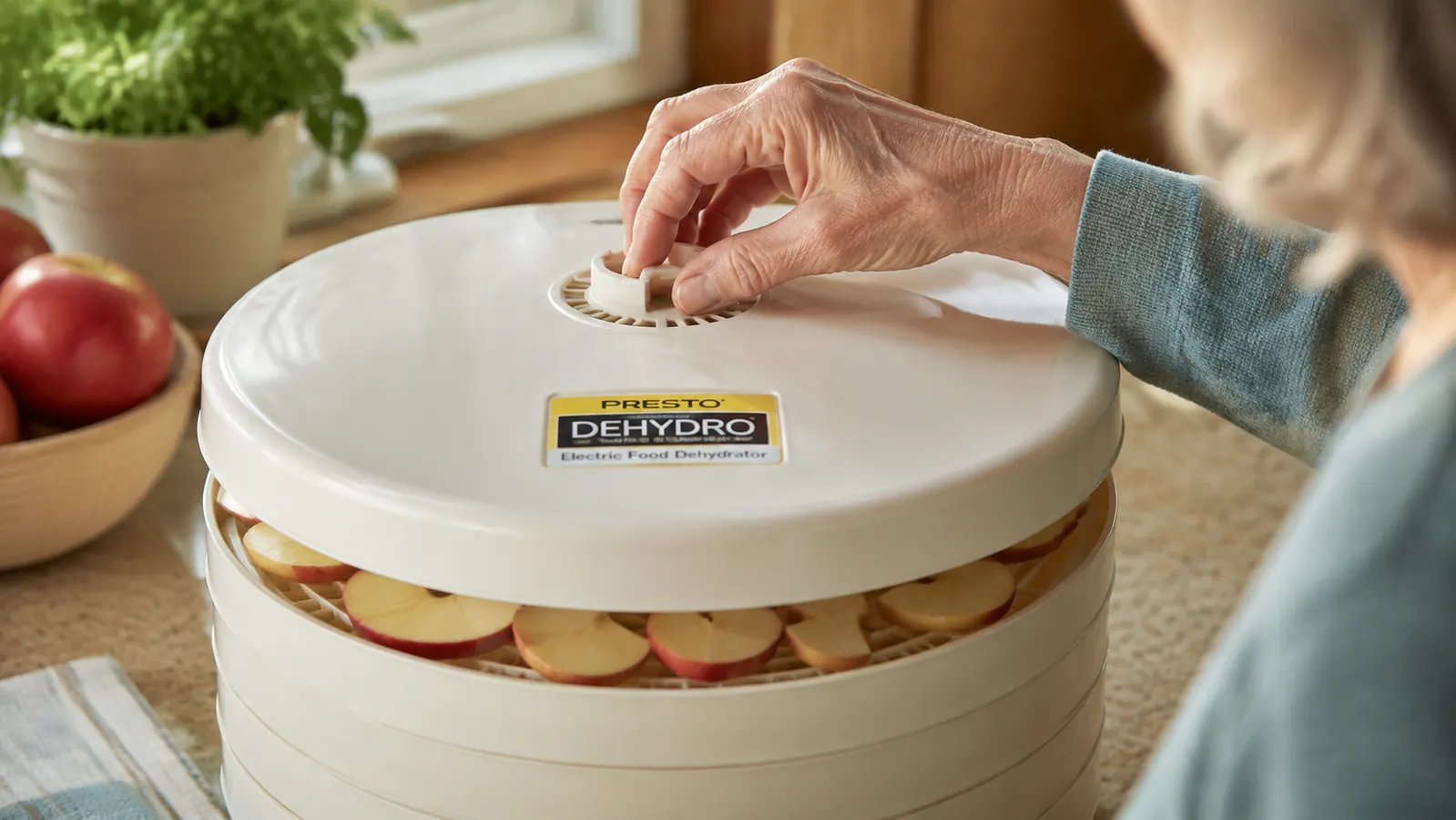
The dial is the whole story here. There's one control on top of the lid, I turn it to roughly where I want the temperature to sit, and that's the entire setup. No menu to scroll through, no buttons to press in a particular order, nothing to reprogram if the power flickers for a second. For someone like me who dries food maybe twice a month and doesn't want to relearn a control panel every time, that simplicity is worth more than an exact number on a screen. I've made peace with estimating rather than reading a precise digital readout, because in three months of use I never once ended up with a ruined batch from not having that number in front of me.
Weight is the other place it wins outright, and at my age that matters more than it might have twenty years ago. I can pick the whole loaded base up with one hand and carry it to the sink when it's time to rinse the trays, and I can lift the stack of trays off the base without any real strain in my wrists. The Cosori's enclosed cabinet design is sturdier looking, but it's genuinely heavier, and I needed both hands and a clear stretch of counter to move it safely, which isn't always convenient on a morning when I'm already juggling breakfast.
Storage is the last honest win, and it's the one that decides things for a lot of small kitchens like mine. When I'm done with a batch, the round trays nest down into a shorter stack than they take up while running, and the whole thing slides onto a pantry shelf without me having to find a dedicated spot for it in a cabinet. The Cosori stays the same tall, boxy shape whether it's mid-batch or sitting empty, which meant it either had to live out on my counter permanently during those three months, or take up a good chunk of cabinet space I don't really have to spare.
Where the Cosori Wins
I want to be fair to the Cosori, because it earned its three months on loan honestly. The digital panel gives you an actual set temperature on the screen, rather than a dial you're turning to a spot you remember, and for someone who wants to follow a recipe's exact drying temperature to the degree, that's a real advantage over my Presto's estimate-by-feel dial. My husband liked being able to see the number confirmed on screen when he was working through a jerky recipe that called for a specific temperature range.
It's also quieter than I expected. The enclosed cabinet design seems to muffle the fan noise more than my Presto's open stacking design does, so if noise is a real concern for you, maybe you run it overnight in a room near where someone sleeps, that's worth weighing seriously. And once it's mid-batch with trays loaded, it holds a full set inside one cabinet without the stack growing taller and taller the way my Presto does when I add extra trays for a bigger batch.
When the Digital Temperature Control Actually Matters
That digital panel earns its keep on some batches more than others. Drying apple rings or basil, I've never missed the dial by enough to matter, fruit and herbs are forgiving. Jerky and yogurt are different. My husband's turkey jerky recipe calls for a specific temperature held steady for hours, and the Cosori's screen let him dial in that number and trust it held. I tried eyeballing the same number on the Presto's dial and got close, but close isn't the same as knowing it's holding. Yogurt is another spot where a steady, exact temperature matters more than it does for dried oregano.
Here's my honest answer on who should spend the extra money on the Cosori. If you make jerky or yogurt regularly rather than once or twice a season, if you follow recipes closely and want a number on a screen instead of a dial position you're remembering, the Cosori is worth the higher price. I'm not that cook, and my husband only makes jerky a handful of times a year, so the dial was enough for us. But the digital control isn't just a nice-to-have for everyone, it genuinely matters for some kitchens.
Storage Between Seasons, Overnight Noise, and Room to Grow
Between seasons, the two machines live very differently in my kitchen. The Presto's trays nest into a stack barely taller than a stockpot and slide onto the same pantry shelf where it's sat for two years. The Cosori never got smaller no matter how I stored it, empty or full it's the same tall cabinet, so for three months it either sat out on my counter or went into a lower cabinet where I had to shuffle two other pans to make room. Shallow cabinets like mine make this worth thinking through.
Jerky runs long, often eight hours or more, and I let a batch go overnight in both machines to compare. The Presto's open stacking design puts the fan right out in the open, and I could hear a steady hum from my bedroom two rooms away with the door cracked. The Cosori's enclosed cabinet muffled that same fan enough that I couldn't hear it down the hall. If you're a light sleeper, that's a real point in the Cosori's favor.
Expanding capacity works differently on each one. Presto sells additional trays separately, so the stack grows taller on the same base, though it starts to feel top-heavy after a point. The Cosori's trays are fixed to whatever the cabinet holds, no smaller and no larger, so once every tray is filled, that's your ceiling for a batch. For most of what I dry, one full load of either machine covers a week's worth of fruit, so this hasn't been a real limitation for me, but it's worth knowing before you choose.

One Thing Neither One Gets Right
Neither machine tells you exactly when a batch is actually done. Both of them will run for however long you set the timer or however long you decide to check on it, but drying time depends so much on how thick you slice things, how much moisture is in the fruit that week, and even how humid the kitchen is, that I still end up checking by hand, breaking a piece and feeling for the right amount of chew, no matter which dehydrator I'm using. If you're expecting either one to just tell you it's finished, you'll be disappointed by both.
I also noticed both machines smell up the kitchen a bit while jerky is running, more so than fruit or herbs. That's just the nature of drying marinated meat at a low temperature for hours, not something specific to either brand, but if you're sensitive to that, running either dehydrator in a mudroom or garage, if you have one, is worth considering regardless of which you choose.
Tired of Relearning a Control Panel Every Time You Dry a Batch?
The Presto Dehydro comes down to one dial and a stack of trays that nest into a short pile when you're done. See today's price and current availability on Amazon.
Amazon Check Today's Price on Amazon →A Story That Sealed It For Me
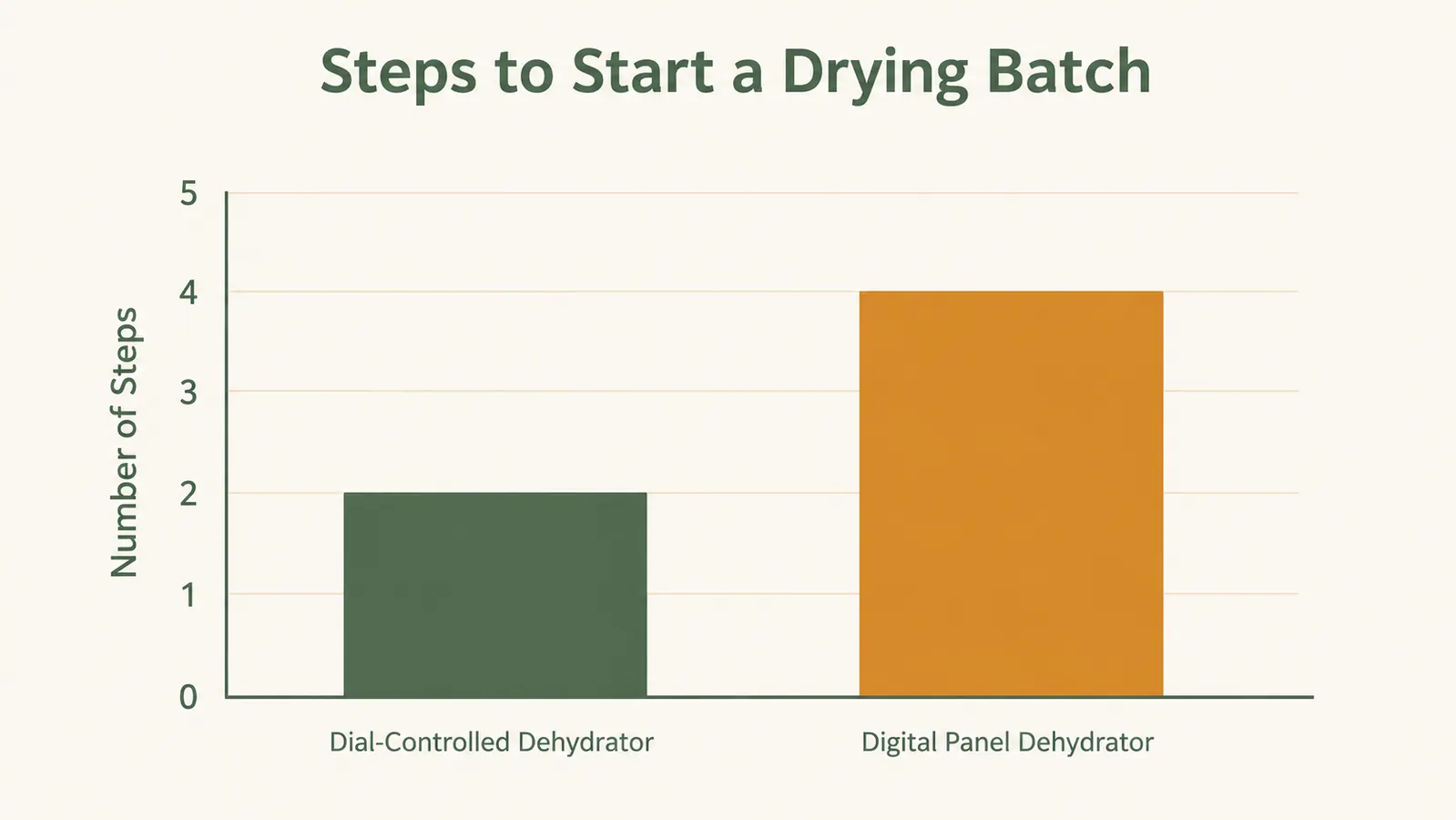
The morning that really decided this for me had nothing to do with a spec sheet. I was running a batch of apple rings in each machine at the same time, trying to get them started before I left for a doctor's appointment I was already running behind on. Loading the Presto took me maybe two minutes, arrange the slices on the trays, stack them, turn the dial, done. The Cosori took longer, not by much, but I had to stop and think through the button sequence to set the temperature and timer, and with the clock already against me, those extra thirty seconds of hesitation were the difference between leaving on time and leaving late.
It's a small thing, I know, a handful of button presses isn't a real design flaw. But at my stage of life, with mornings that are already full before the first task even starts, the machine that asks the least of me on a rushed day is the one I trust to still be out on the counter next season. That's really what tipped this whole comparison, more than any single feature on its own.
Who Should Buy Which
If you like following recipes to an exact temperature, you dry large batches often enough that stacking capacity inside one cabinet matters, and a bit more weight and a taller footprint on the counter don't bother you, the Cosori is a genuinely capable machine and I wouldn't talk you out of it. It handled everything I threw at it over three months without a single failed batch.
If you dry food occasionally rather than constantly, you want something light enough to carry to the sink with one hand, and you'd rather turn a dial than remember a button sequence, the Presto Dehydro is the one I'd point you toward. It's the machine that's still on my pantry shelf today, and after three months of running both side by side, that's the honest answer. If you want the full story on how it's held up for me, I wrote a separate honest review after using it regularly, and I put together how to dehydrate fruit and herbs at home if you want the exact routine I use with it.
See Why This Is the Dehydrator Still on My Pantry Shelf
After three months running it against a digital model, this is the one I keep reaching for. Check today's price and current availability on Amazon.
Amazon Check Today's Price on Amazon →